How Daft Punk Helped Launch Kavinsky
The French duo gave one of synthwave’s biggest names an early push.

When people think of Kavinsky, they usually think of “Nightcall” and Drive.
But before that, there was Daft Punk.
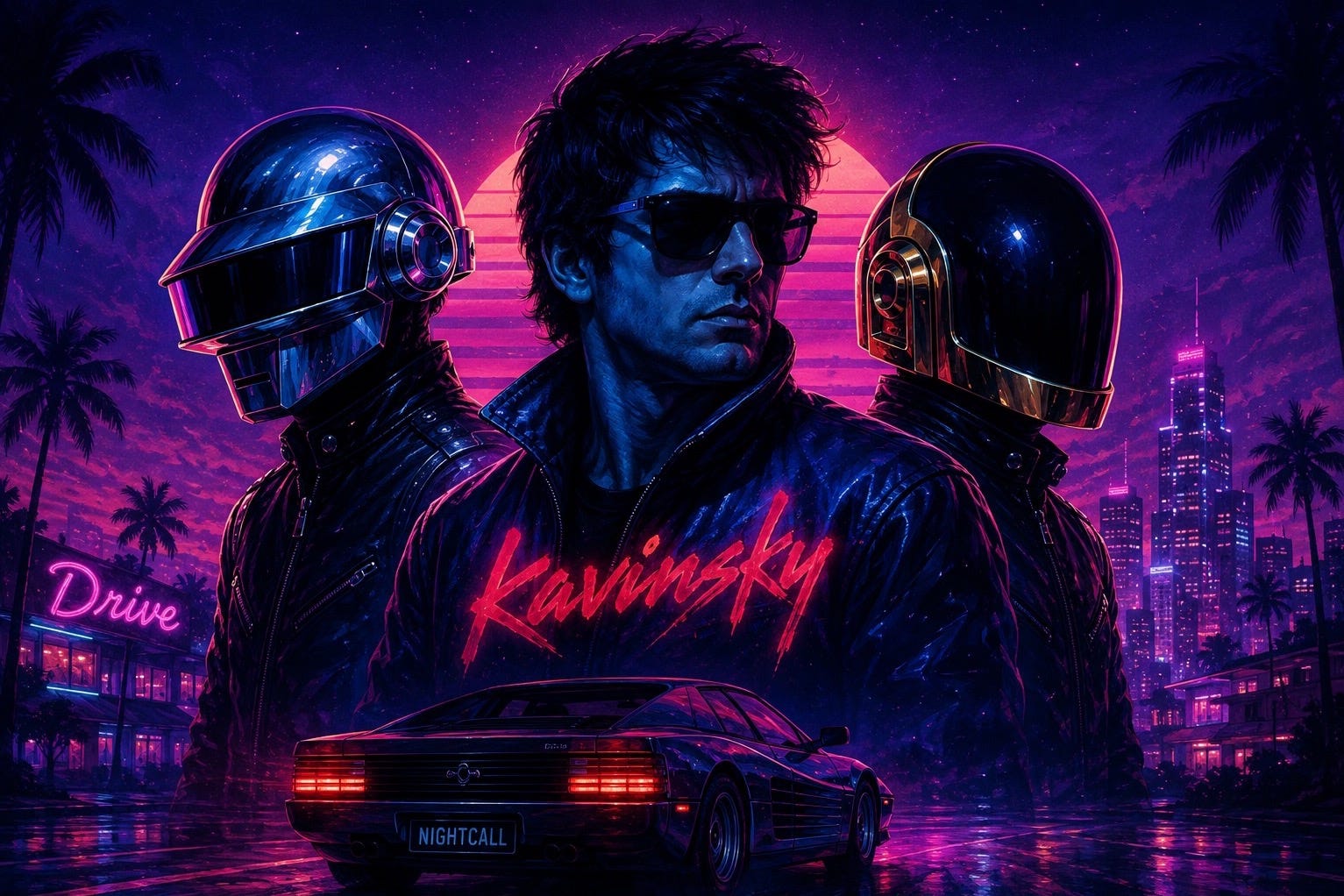
As Kavinsky was finding his sound, Daft Punk gave him one of the biggest breaks an up-and-coming electronic artist could ask for: they invited him to open on the Alive 2007 tour. Night after night, his retro-futuristic sound reached thousands of fans before Daft Punk took the stage.
Their support didn’t stop there.
Guy-Manuel de Homem-Christo later co-produced “Nightcall,” the song that introduced millions of people to Kavinsky’s neon-soaked world. Daft Punk were pushing electronic music into the future, while Kavinsky was looking back, channeling the soundtracks, fast cars, and glowing city streets of the 1980s.
I love finding connections like this.
Daft Punk weren’t just making incredible music. They were helping shine a light on artists who would go on to shape entirely different corners of electronic music.
If you’ve already read my articles on Daft Punk and synthwave, Kavinsky is the bridge between the two.
Today I learned of the passing of Vincent Belorgey, better known as Kavinsky.
Like so many others, I discovered him through Nightcall and Drive. But the more I learned about his story, the more I appreciated the path he took—from opening for Daft Punk to helping define the sound of synthwave for a new generation.
His music had a way of making nostalgia feel new. A few synthesizers, a steady beat, and suddenly you were driving through a neon-lit city that only existed in your imagination.
Thank you for the music, Vincent. Your influence will live on forever.
Related Reading
Footnotes
In a 2007 interview with Pitchfork, Thomas Bangalter was asked what he’d been listening to recently. The first record he mentioned was Kavinsky’s “Testarossa Autodrive,” an early sign of Daft Punk’s admiration for his work.
Kavinsky opened on Daft Punk’s legendary Alive 2007 tour. A few years later, Guy-Manuel de Homem-Christo co-produced “Nightcall,” the breakthrough single that became synonymous with Drive and introduced synthwave to a much wider audience.